


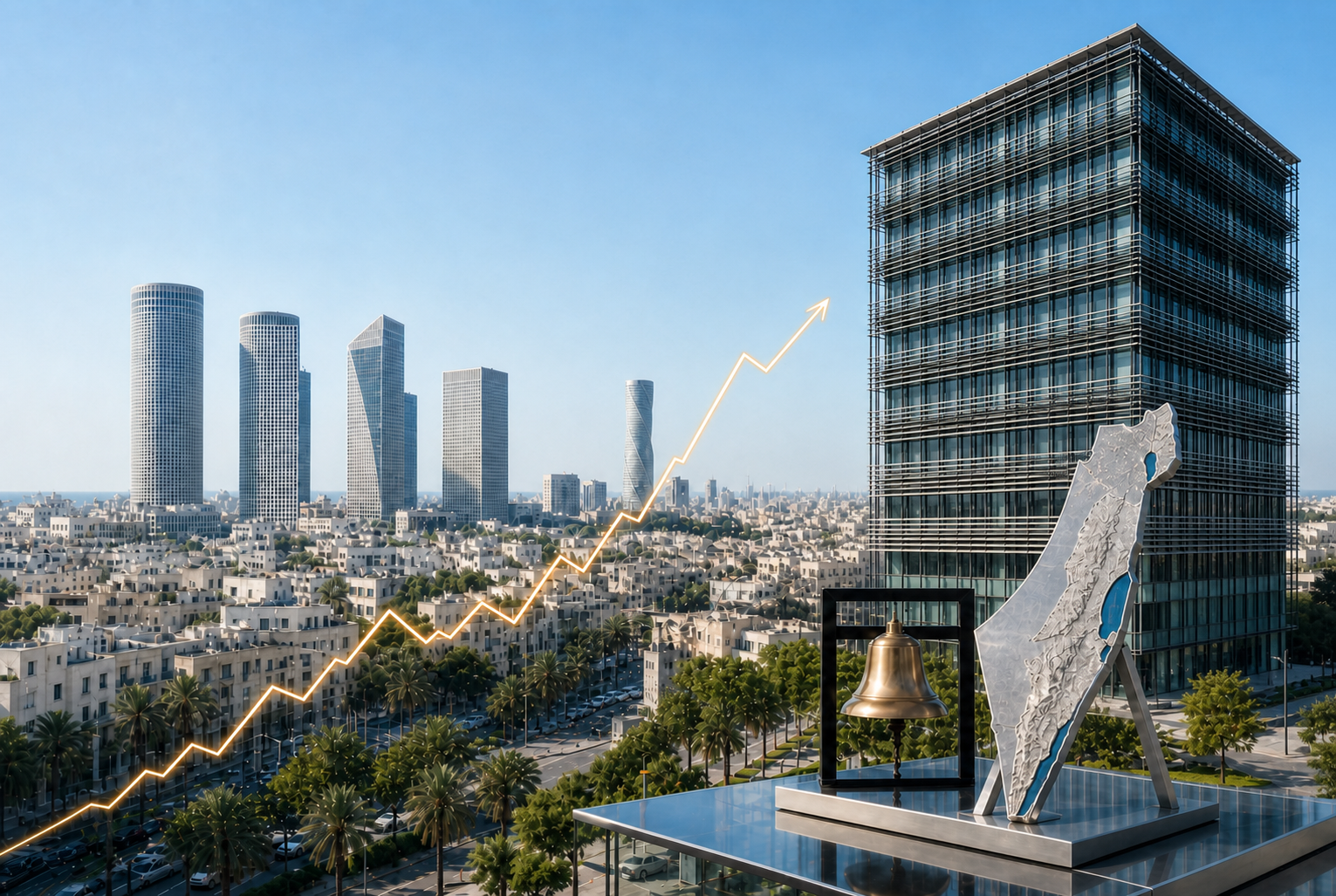
The Tel Aviv Stock Exchange (TASE) is becoming easier for global investors to access. A Monday–Friday trading week, rising liquidity, new futures contracts, and increased foreign participation are bringing TASE closer to global market norms—even as geopolitical, currency, and liquidity risks remain significant.
Key Takeaways
- TASE’s Monday–Friday schedule provides greater overlap with international markets.
- Equity-trading volumes and foreign participation have increased materially.
- New futures products are giving institutions better tools for managing exposure.
- Israel’s IPO market strengthened during the first half of 2026.
- Geopolitical, currency, and liquidity risks remain important considerations.
Last updated: August 30, 2026
What was once viewed by many foreign investors as a relatively small regional market is increasingly behaving like a more globally connected exchange. Trading volumes are rising, foreign participation is improving, and market reforms are reshaping liquidity conditions across equities, bonds, and derivatives.
International investors have historically faced several structural limitations in Israel’s capital market, including liquidity constraints, differences in the trading calendar, and limited accessibility. Those obstacles have not disappeared, but conditions have improved materially.
During the first half of 2026, average daily equity-trading volume reached NIS 5.7 billion, while TASE’s equity-market capitalization reached NIS 2.7 trillion at the end of the second quarter. These figures suggest that Israel’s capital market is becoming deeper, more tradable, and increasingly relevant to international investors. According to TASE’s first-half 2026 results, trading activity and foreign participation increased following the transition to Friday trading.
Why is the Tel Aviv Stock Exchange attracting foreign interest?
The primary drivers are stronger liquidity, improved access, market reform, and exposure to sectors with long-term global relevance.
Average daily equity-trading volume reached NIS 5.7 billion during the first half of 2026, an increase of 65% compared with the average for 2025. The exchange also reported a substantial increase in foreign participation following its transition to a Monday–Friday trading week.
For foreign institutions, market accessibility can matter as much as political headlines. Global investors may accept volatility when a market remains liquid and operational. Historically, Israel’s Sunday–Thursday trading week created friction for portfolio managers in London, New York, and other global financial centers by limiting overlap with international trading hours.
The new calendar reduces some of that friction, making Israeli securities easier for international investors to monitor and trade alongside positions in other developed markets.
Key developments driving foreign interest
| Development | Why it matters |
|---|---|
| Monday–Friday trading week | Greater overlap with international financial markets |
| Rising equity-trading volume | Easier execution for institutional investors |
| Higher foreign participation | Evidence of growing international engagement |
| Tailor-Made market-making program | Improved liquidity in participating equities |
| Expansion of equity-index futures | More effective hedging and exposure-management tools |
What changed after the move to a Monday–Friday trading week?
The calendar change aligned TASE more closely with global markets and was followed by higher Friday trading volumes and increased foreign participation.
During the first half of 2026, average Friday equity-trading volume reached NIS 4.6 billion, compared with average Sunday volume of NIS 1.6 billion in 2025. Foreign investors accounted for 41% of Friday trading, compared with 12.5% on Sundays in 2025.
This matters because global capital tends to favor markets that fit naturally into international workflows. Greater synchronization with European and U.S. markets can improve execution, price discovery, arbitrage activity, and institutional engagement.
For years, Israel’s trading calendar was an anomaly. It now resembles the schedule used by most developed exchanges.
The reform may also improve Israel’s position in global asset-allocation decisions. Large passive and institutional funds prefer markets that align operationally with international standards. Israel is already classified within developed-market benchmarks, but greater tradability may support larger allocations over time.
Why are Israeli equities outperforming despite geopolitical risk?
Israeli equities showed notable resilience during the first quarter of 2026, supported by sector composition, domestic capital flows, and continued economic activity.
The TA-35 gained 12.9% year to date as of August 30, 2026, while the Dow Jones Industrial Average gained 10.7% over the same period.
This performance may appear counterintuitive. Israeli markets continued operating amid regional conflict and heightened tensions involving Iran and Hezbollah.
Part of the explanation lies in sector composition. Israeli indices include substantial exposure to banks, defense-related businesses, energy infrastructure, and technology companies that have benefited from domestic activity and increased global security spending.
Another factor is capital repatriation. According to TASE data, Israeli investors reduced exposure to some foreign-equity products while increasing purchases of local index products.
Foreign investors may also be distinguishing between short-term geopolitical headlines and Israel’s longer-term economic and technological capabilities. The economy’s continued operation through prolonged instability has become part of the investment case.
How is TASE improving liquidity and market structure?
TASE is addressing liquidity through market making, new derivatives, and reforms intended to broaden participation.
Liquidity at the scale required by international institutions remains a central challenge for Israel’s capital market. Smaller markets often have wider spreads, lower institutional participation, and less trading depth than larger developed exchanges.
One notable initiative is the Tailor-Made market-making program, which is designed to improve liquidity and broaden the investor base for participating companies. According to TASE management, foreign investors accounted for approximately 37% of trading in Tailor-Made equities during the first quarter of 2026, compared with approximately 31% across the wider equity market.
The exchange is also expanding its derivatives market. Since TASE launched futures on the TA-35, TA-90, and TA-Banks5 indices in September 2024, combined monthly equity-index futures volume grew from approximately 7,500 contracts in December 2024 to approximately 127,500 in July 2026. TASE expanded the market further by launching TA-125 futures in March 2026; those contracts accounted for approximately 37,500 contracts in July. These July figures are calculated from TASE’s reported daily averages across 22 trading days. View TASE’s derivatives trading statistics.
This development is important because institutional investors require effective hedging tools. A deeper derivatives market allows foreign funds to manage exposure more efficiently instead of treating Israeli equities as purely directional investments.
Why are foreign investors becoming more active in Israeli stocks?
Foreign investors are gaining better access to Israeli companies offering exposure to innovation, cybersecurity, defense technology, healthcare, and energy infrastructure.
Many international investors want exposure to these themes but have historically viewed the local market as too narrow or illiquid. That perception is beginning to change as trading conditions improve and the range of listed and tradable products expands.
IPO activity also accelerated. During the first half of 2026, 15 new companies completed IPOs on TASE, raising approximately NIS 6.1 billion, compared with nine IPOs during the same period in 2025.
Meanwhile, the Israeli government successfully raised capital in domestic and international debt markets during a period of geopolitical stress. That reinforced confidence that global capital markets remained accessible to Israeli issuers.
Foreign investors are also paying closer attention to Israel’s defense and security ecosystem. Technologies developed and tested locally are increasingly relevant to global demand, particularly in drones, cybersecurity, missile defense, and intelligence systems. For additional context, read The Rise of Israeli Defense Stocks: What Global Investors Need to Know Now.
For international investors, TASE increasingly offers exposure to sectors tied to long-term technological and geopolitical trends rather than only to Israel’s domestic economic cycle.
What opportunities and risks should investors understand?
The opportunity is meaningful, but the risks remain substantial.
Israel remains exposed to geopolitical shocks, currency volatility, changing interest rates, and periods of sudden market stress. Liquidity is improving but remains below that of larger developed exchanges, particularly outside the most actively traded securities.
Foreign investors should also recognize that sharp inflows can reverse during periods of heightened uncertainty. Markets that rise rapidly may be vulnerable to equally sharp corrections.
At the same time, completely ignoring Israel is becoming harder for globally diversified investors to justify. The country’s capital market is increasingly connected to major global themes, including defense spending, cybersecurity, energy infrastructure, healthcare innovation, and artificial intelligence.
The relevant question is not simply whether Israel belongs in a portfolio, but what level and type of exposure are appropriate for an investor’s objectives, time horizon, risk tolerance, and broader asset allocation.
Important: This article is provided for general informational and educational purposes only and does not constitute individualized investment, legal, or tax advice. Investing involves risk, including the possible loss of principal. Investors should consult qualified professional advisers before making investment decisions.