

The Israeli shekel has become an increasingly important part of the investment case for Israel. As the currency has appreciated, foreign investors have gained a clearer signal of confidence in Israel’s economy, capital markets, and long-term resilience. For investors seeking international diversification, exposure to Israeli assets now offers not only access to a dynamic market, but also the potential benefit of currency strength.
What Is Driving the Strengthening of the Israeli Shekel?
Over the past 12 months, the Israeli shekel has strengthened sharply, rising to levels not seen in decades. The Israeli currency broke a 32-year high as it moved below the 3 shekels per U.S. dollar mark last week. The shekel has gained roughly 68% against the U.S. dollar since mid-2002.
In just the past 12 months, local currency gained 24% against the USD, outpacing almost all major currencies and signaling a marked shift in market sentiment. Among major freely traded currencies, a 20%+ appreciation in a single year is highly unusual — placing the shekel among the strongest global performers in recent history.
This appreciation reflects a combination of improving geopolitical expectations, resilient economic performance, and supportive global conditions. Recent developments in the Middle East and a decline in Israel’s risk premium have played a central role in shifting investor sentiment, encouraging renewed capital inflows into local markets.
At the same time, the domestic economy has continued to perform, led by its technology sector and supported by steady capital inflows from abroad. Israel’s high-tech industry remains a key driver of foreign currency earnings, while continued startup fundraising and investment activity have helped anchor the shekel’s strength. Even during periods of heightened uncertainty, the economy has demonstrated an ability to absorb shocks without major structural damage.
External factors have also contributed. The broader weakening of the U.S. dollar, alongside the recovery in global equity markets, has reinforced the shekel’s appreciation, particularly through institutional investment flows and hedging activity. Taken together, these forces point to a currency move driven by both domestic fundamentals and global dynamics, rather than a short-term fluctuation.
Why a Strong Shekel Matters for Foreign Investors
A strong shekel signals growing confidence in Israel’s economic and financial system, even against a complex geopolitical backdrop. Currency appreciation typically reflects capital inflows, reduced risk perception, and expectations of future stability, all of which are central considerations for international investors.
For those allocating capital, currency direction has a direct impact on both risk and return. A strengthening shekel reduces the likelihood that exchange-rate movements will erode gains, while also suggesting that local assets are benefiting from sustained demand. This can make the Israeli capital market more attractive relative to peers, particularly in periods when global investors are seeking resilient and differentiated exposure.
There is also a behavioral dimension. Strong currency performance tends to attract attention from institutional investors tracking relative market strength. As capital reallocates toward outperforming markets, the shekel’s appreciation can reinforce its own momentum, further strengthening the investment case.
How a Strong Shekel Supports Israeli Market Performance
The relationship between currency strength and market performance is often mutually reinforcing. In Israel, the appreciation of the shekel has coincided with gains in the local equity market, pointing to a broader improvement in investor sentiment.
As equity markets rise, they tend to attract additional foreign capital, which in turn supports the currency. This dynamic has been particularly visible in Israel over the past 12 months, with the local equity market (TA-35) delivering gains of around 77% alongside a 24% appreciation in the shekel against the USD. Combined together, the TA-35 delivered a118% gain in USD-terms.
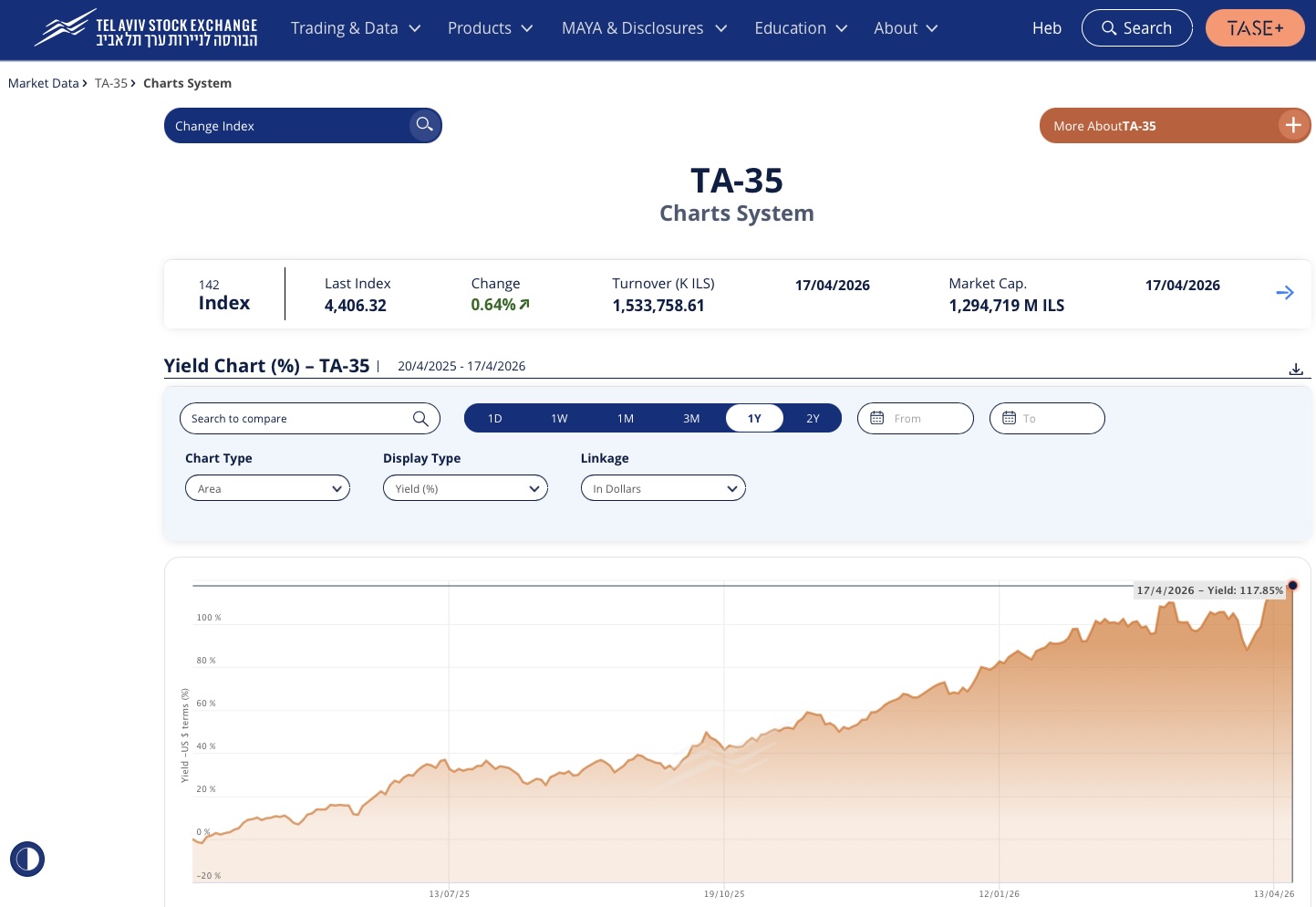
This creates a feedback loop in which stronger markets and a stronger currency reinforce one another. For foreign investors, this alignment can enhance both entry conditions and potential returns.
Institutional investment strategies further amplify this dynamic. Global funds reallocating toward markets demonstrating relative strength can increase exposure to Israeli assets, adding momentum to both market performance and currency appreciation. In such an environment, the shekel becomes both a reflection of investor confidence and a driver of broader market momentum.
Also, the strengthening of the shekel is good news for many Israelis. The strengthening of the shekel is leading to price reductions in retail chains, airline tickets, and overseas shopping, and supports Israeli consumers by lowering inflation. This is fueling Israeli consumption as the war begins to wane.
Israeli importers and retail chains benefit significantly from the strengthening shekel. Expenses are in cheaper foreign currency and revenues are in strong shekels.
One example of this dynamic can be seen in the Israeli stock Neto Malinda, a food importer our firm currently holds. Although the company does not officially disclose FX impact, estimates suggest that every 1% strengthening of the shekel adds about 17 million shekels to its bottom line.
How Shekel Strength Reflects Israel’s Economic Stability
Sustained appreciation in a currency is usually grounded in underlying economic fundamentals rather than short-term movements. In Israel’s case, the shekel’s strength reflects a combination of sectoral competitiveness, macroeconomic resilience, and continued access to global capital.
The country’s high-tech sector remains a central pillar, generating foreign-currency earnings and attracting international investment. As of late 2025, high-tech accounts for approximately 20% of Israel’s GDP and over 50% of its exports, while also leading the OECD in private-sector R&D expenditure as a share of GDP. This concentration of innovation and export capacity provides a steady inflow of foreign currency, helping to underpin the shekel. Alongside this, defense exports are expected to expand, adding further support to external demand.
More broadly, Israel has demonstrated an ability to maintain economic activity and investor confidence even under pressure. This resilience is a key factor for foreign investors, who tend to favor markets capable of navigating volatility without significant disruption. In this context, the shekel’s performance can be seen as a reflection of structural strength rather than temporary momentum.
Key Advantages for Foreign Investors in Israel’s Capital Market
A strong shekel enhances the attractiveness of Israel’s capital market in several practical ways, particularly for investors with a medium- to long-term horizon.
- Currency tailwinds: Returns generated in shekels may be amplified when converted into investor's local currency if appreciation continues
- Lower perceived risk: A strengthening currency is often associated with declining country risk premiums, improving the risk-reward profile of local assets
- Access to growth sectors: Israel offers exposure to globally competitive industries, especially technology and defense, which continue to attract international demand
- Supportive capital flows: Currency strength typically reflects sustained inflows, which can underpin asset prices and market liquidity
These advantages position Israel as a market where currency dynamics and economic fundamentals align, creating a more compelling environment for foreign capital.
Can Shekel Appreciation Improve Investment Returns?
For foreign investors, the impact of a strengthening shekel extends beyond market dynamics to directly influence realized returns. Currency appreciation can play a meaningful role in enhancing total returns for non-Israeli investors. In the case of the shekel, its recent outperformance has provided an additional layer of return alongside gains in underlying assets.
The mechanism is straightforward. Investors convert foreign currency into shekels, invest in local assets, and later convert back. If the shekel has appreciated during that period, the value of those returns increases in the investor’s currency. This creates a dual-return effect, combining asset performance with favorable exchange-rate movements.
In an environment where currency strength is supported by economic fundamentals rather than short-term volatility, this effect becomes particularly relevant. It not only enhances returns but also contributes to portfolio diversification, especially for investors seeking exposure beyond traditional markets.
Start Your Currency Diversification Plan Today
IMPORTANT DISCLOSURES & RISK INFORMATION
This content is provided for educational and informational purposes only and does not constitute investment advice, a solicitation, or an offer to buy or sell any securities. Investing in international markets, including the Israeli stock market, involves material risks, including but not limited to currency risk and the potential loss of principal. Wise Money Israel does not guarantee any specific outcome, return, or profit. Individuals should consult with a qualified financial advisor, tax professional, and/or legal counsel before making any investment decisions. Diversification does not necessarily ensure a profit or protect against loss. © 2026 Wise Money Israel. All rights reserved.